(35of55).jpg)
September 25, 2026
Buffalo Rising
BECKY SHAW Delivers a Wild Roller Coaster Ride
Read More


We're deep into Season 47 — Becky Shaw is on stage now through October 3, and The Haunting of Hooverton Hotel opens October 24.
A Christmas Carol returns for the holidays this December, with The Hateful Elf, The Rink at the End of the World, and The Frogs still ahead as the season continues.
If you're from out of town, haven't been to see a show here in a while, never got off the couch since lockdown ended, or if you're one of our loyal subscribers... I know you're going to love this show and our season.
Stop me and say hi when you're in the lobby! I'd love to meet you.

Chris J Handley
Executive Artistic Director
Theater Talk Buffalo
Together, the five move through Diaz's language with exhilarating control, keeping the rhythms light and witty even as the moral pressure in the room becomes increasingly dizzying. Handley wisely lets Diaz's structure do its work, trusting the material rather than imposing a directorial signature on it.
Kristoffer Diaz is a Pulitzer Prize finalist and Tony nominee, and Alleyway Theatre has landed his newest play for its Western New York premiere. Things with Friends is a wickedly dark comedy, and it arrives with the formal sophistication of a playwright who is in control of his craft. From its opening moments, the play constructs an elaborate architecture of opposites, and Diaz, with considerable nerve and wit, will proceed to take it apart.
Diaz employs a device also used by Bertolt Brecht and made famous by Thornton Wilder: the omniscient narrator who guides us through the action. This narrator, played with whimsical energy by Smirna Mercedes, is not the Stage Manager of Wilder’s Our Town; she claims, in fact, to be a playwright, the author of this very play. She emerges from the audience, pride overcoming modesty, and boasts, "I wrote this!" She will guide us through this story about her town.
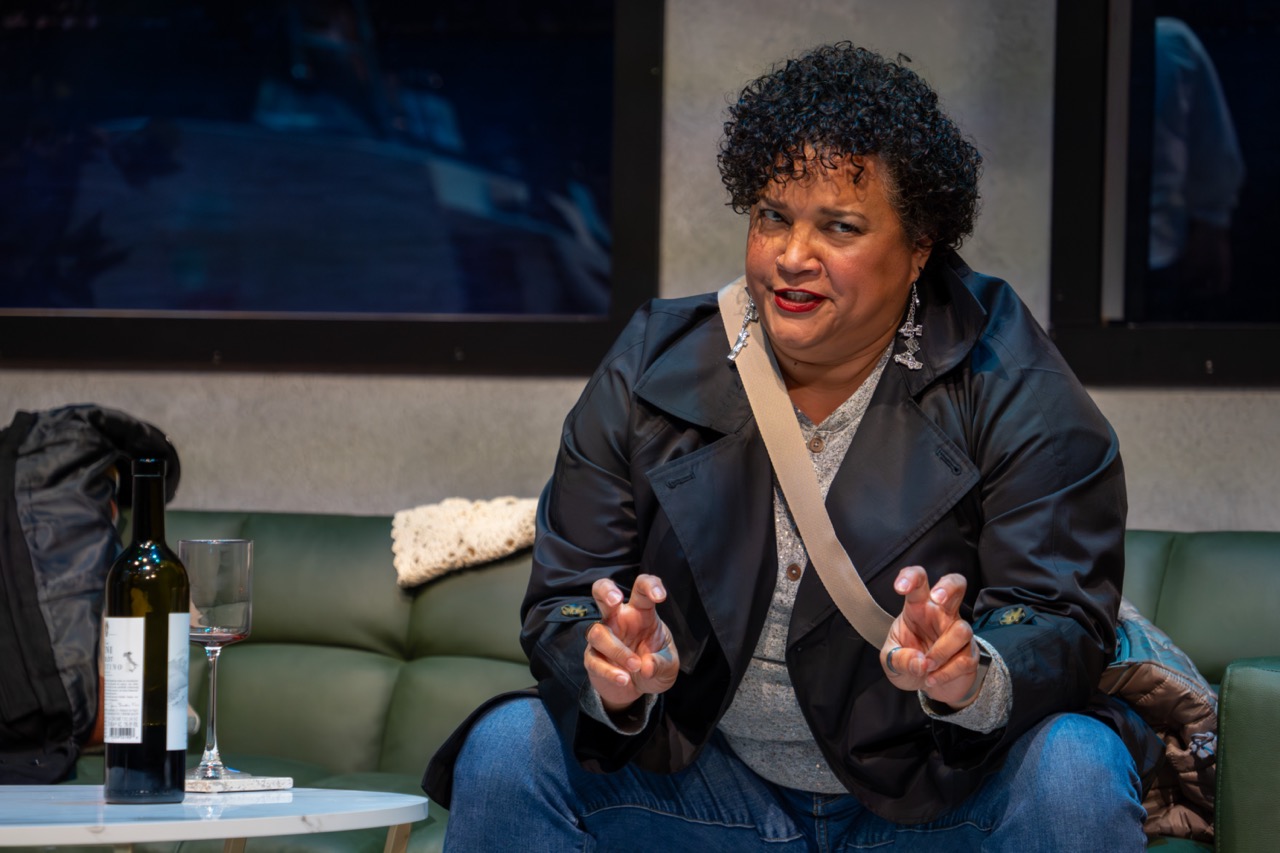
Mercedes handles the role of the narrator, a heavy lift of monologue, with flair and unflagging nonchalance. Her cheerfulness keeps her emotionally remote from the characters' dilemmas, a distance reinforced by differences of class and education. They are affluent and arguably pretentious; she is down to earth. She keeps the tone buoyant and conspiratorial, tossing off exposition with a stand‑up comic’s ease, giving space to the contradiction between her cheerful fascination with the proceedings and their alarming nature.
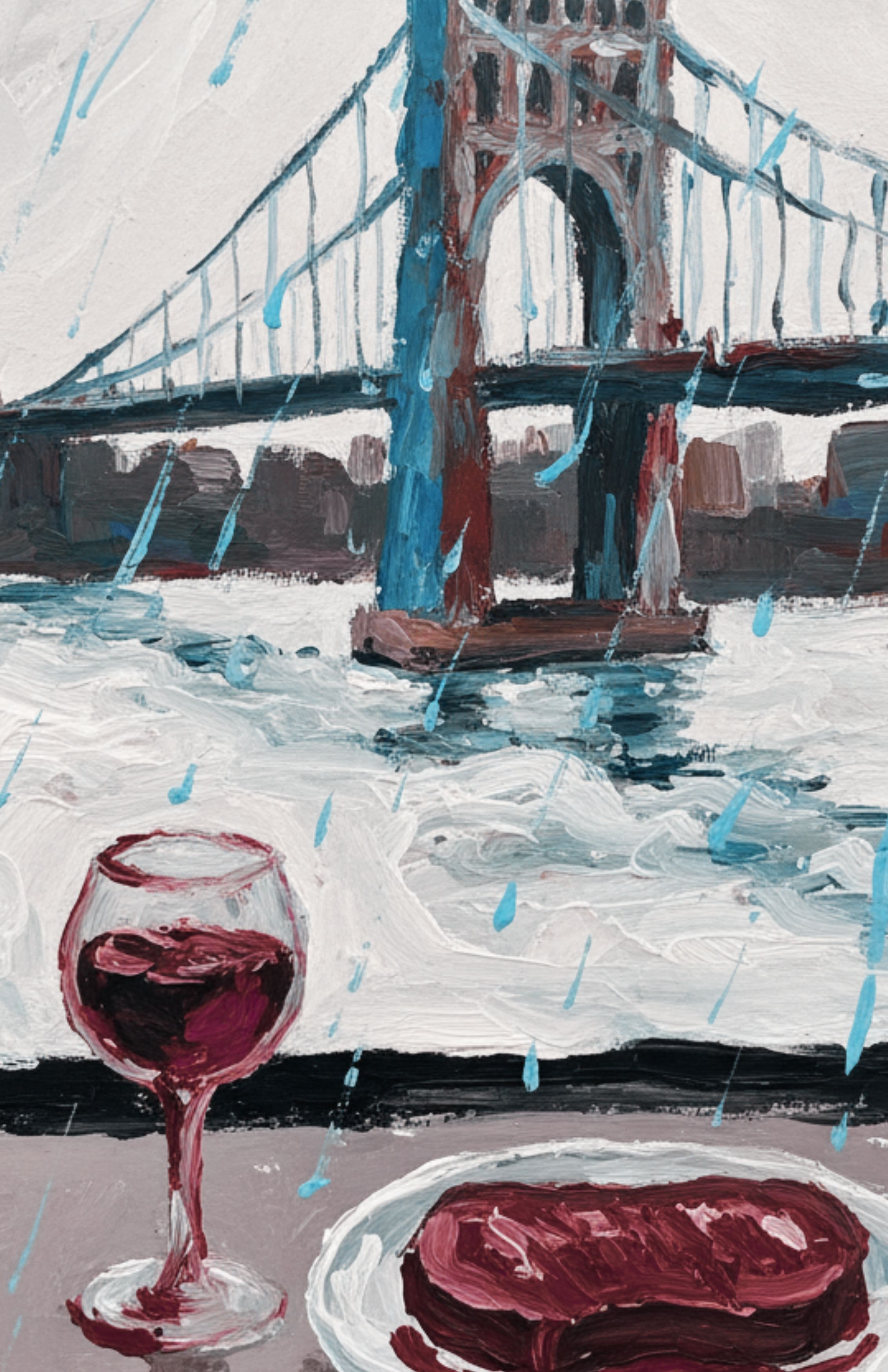
This town is not Grover’s Corners in rural New Hampshire. Tonight, our town will be Manhattan, sometime in the future, when global warming has clearly been wreaking havoc. In fact, the city seems to be crumbling under the stress of an impossible deluge of merciless rain. The George Washington Bridge has collapsed and the Brooklyn-Battery Tunnel, connecting Manhattan and Brooklyn has sprung a leak, rendering it useless.
These disasters have left Manhattan isolated, no longer the center of its universe. New Yorkers have fled in droves for the sanctuary of New Jersey, which has, in this new environment, become the crossroads of America. If you are familiar with the socio-geographic hierarchies of New York City at all, you already understand that this is a world turned upside down.
Diaz’s play turns on a series of opposites: the haves and the have nots; the greedy and the giving; winners and losers; the civilized and the uncivilized; the users and the used. In simpler terms, this is a comedy about a dinner party that turns into a moral ambush.
We meet two affluent but not rich couples. Burt and Adele live in Manhattan; Vy and Chabby have moved to New Jersey.
Burt and Adele are the hosts; Vy and Chabby have come as guests — and we know how hosts and guests are supposed to behave.
This is a dinner party: pleasure rather than business; another binary division.
Keep track of these polar divisions, because when his play takes an absurdist turn, Diaz flips every one of them.
As narrator, Mercedes eases us into the action, sometimes walking directly through the well-appointed living room, unseen by the characters in the play, commenting, telling us the inner thoughts of these highly civilized people, and punctuating their choices with comic observation.
Burt and Adele are waiting for their guests, who are late. In fact, with the bridge collapsed, it is possible that they won’t be coming at all. Despite the worrisome state of the city, the couple blithely set the scene for a gracious and casual evening. The dinner is to be steak. Adele puts breezy 1960s French yé‑yé pop on the phonograph.
Beneath the upbeat tone, we begin to sense the anxiety of Manhattan’s new realignment in the world. There’s only one bottle of wine left. We infer that this might be the very last bottle of wine available for a very long time. Adele misses the spectacular view of the bridge that they used to enjoy from the window of their 27th floor apartment. Most ominously of all, there might be rain.
Director Chris J. Handley’s production underscores this uneasy balance. The actors never play just one note. As the evening progresses, we find ourselves thinking back: Why was Vy so eager to refill the wine glasses? Why is Chabby so full of flattery, and why is he so fixated on those shovels? Art history majors might have an advantage with the shovels. Think Magritte: Ceci n'est pas une pipe, this is not a pipe.
The living room set by Tania Barrenechea is similarly ambiguous in its impact. Its tasteful mid-century comforts, strategically placed artworks, formidable modern kitchen, and expansive 27th-floor view, including a massive picture window through which a storm will be plainly visible, sit under exposing light by Emma Schimminger that adds little warmth to the space. Objects on the set seem like clues in those murder mystery puzzles – are the umbrellas a clue? Are the bottles of Peregrino water a clue?
There is no personality here, merely strategic social statement. Schimminger’s sound design lets the storm outside and those chirpy yé‑yé tracks jostle for control of the room – another binary: nature vs. culture. This division too will be undone before the night is through.
Burt and Adele decide to go ahead with dinner, but just as they begin to enjoy the meat, their guests do arrive. They were detained. They had “a thing” to attend. Vy and Chabby are socially well-connected. They always have “a thing” to attend.
And here we arrive at the elusive title of the play, "Things with Friends," which echoes Donald Margulies’ Pulitzer‑winning play Dinner with Friends, or Richard Yates’s short story, “Fun with a Stranger,” which is similarly coded in binary terms. These are titles that offer a wry, slightly generic binomial that does double duty, seemingly evoking social pleasantries while actually harboring the threat of ominous, unspecific events.
So Vy and Chabby had a “thing.” It seems that Burt and Adele were lucky that their old friends could squeeze them in at all.
At this point, the play takes its decidedly absurdist turn. Vy and Chabby have an agenda.
It now becomes difficult to talk about Things with Friends without giving away the plot. And yet, I think it might be helpful, given how disorienting absurdist theater can be for the uninitiated, to offer some kind of road map. As Vy and Chabby were going in for their metaphoric kill, my companion whispered to me, “Eugène Ionesco.” I whispered back, “Luis Buñuel.”
It’s that kind of play. It splices Romanian‑French playwright Eugène Ionesco’s absurdist intrusion of dread into a bourgeois living room with Spanish‑Mexican filmmaker Luis Buñuel’s taste for dinner parties as moral traps, where polite ritual barely conceals predation and apocalypse. Bourgeois ritual evolves into crucible. And it is, at bottom, very funny.
Diaz himself cites Edward Albee’s Who’s Afraid of Virginia Woolf as an inspiration, though Albee’s A Delicate Balance, in which Agnes and Tobias see their carefully ordered lives upended by the unexpected arrival of their longtime friends Harry and Edna, might be the closer match.
As hosts, David Mitchell and Sarah French give Burt and Adele an unassuming charm, before the evening tilts from hospitality to siege and their comfortable sophistication devolves into the darkly ridiculous. In Mitchell, we see Burt’s patience and sense of decorum fray, while French leans into Adele’s more trusting and diplomatic nature. Trust and mistrust are an important pair in this play. Adele is a woman who never asks who’s at the door before buzzing them in, and who trusts, even as possible apocalypse approaches, that a case of wine she has ordered will be delivered.
Shanntina Moore and Stan Klimecko as Vy and Chabby, meet the charisma of their hosts with a sleek, practiced, and needling confidence, the sort of bright social ease that makes their “agenda” unsurprising but renders their tactics shocking. Moore, in particular, with her heavily shadowed eyes and skill for the slow take, evokes the aura of a skillful card shark, while Klimecko gives Chabby an air of brute carelessness.
As Chabby and Vy’s daughter, Chabby Jr. (“Joony”), Sunny Griffith is a textbook example of a child who has absorbed her parents’ behaviors but puts them to radically different use. It is that familiar moment of “You always told me to stand up for what I believed,” spoken to parents who assumed their child would share their beliefs. Griffith shows us a girl from a family accustomed to getting what it wants, yet her ethics and generosity, including a willingness to have fun with strangers, stand in comic contrast with the values of the parents who raised her. Griffith walks this line so confidently that Joony often seems like the only adult in the room, even as she recounts hilariously adolescent misbehavior.
The arrival of Joony sets her parents’ agenda out of kilter. Add the implications of another division: how we treat friends and how we treat family. This insight, inspired by observing Adele’s sincere affection for Joony, jolts Vy out of her self-absorption and into an uncharacteristic gesture of human compassion. I’ll say no more.
Together, the five move through Diaz's language with exhilarating control, keeping the rhythms light and witty even as the moral pressure in the room becomes increasingly dizzying. Handley wisely lets Diaz's structure do its work, trusting the material rather than imposing a directorial signature on it.
The food in Things with Friends, effectively designed by Quincey Miracle, carries a heavy symbolic load. At their sophisticated soirée, Burt and Adele will serve a meal of meat and potatoes. At one point, the vision of vegetarian Joony tearing into an absurdly bloody steak is cross-referenced with the serving of that ultimate in elaborate and sophisticated haute cuisine, perfectly ordinary baked sweet potatoes. Those opposites come back to haunt the table: the civilized and the primitive; the carnivore and the vegetarian; the raw and the cooked. What began as metaphor is becoming uncomfortably literal.
At various points, the ever chipper narrator speculates about what is about to happen. Sometimes she says something won’t happen, until it does. At other times she tells the audience, with apparent generosity, “You decide.”
But we never get to decide. Events unfold with the inevitability of fate, for as we will be reminded, no matter how we live our lives, no matter what decisions we make, who we cheat or what we sacrifice, as in Our Town, every human story ends the same way. Diaz cleverly reminds us that at a time when civic generosity erodes, predatory behavior becomes normalized, social contracts collapse, and the powerful openly prey on the vulnerable while calling it strategy, each of us faces a choice. We are obliged to determine what really matters and to choose between the selfish and the humane. In view of today’s headlines, Diaz's dark comedy feels less like entertainment than like diagnosis.
Things with Friends is a playfully challenging evening, and bracingly so. Buffalo theatergoers who surrender to its absurdist logic will find that Diaz rewards them with an ending that is simultaneously tidy and devastating, which is perhaps the most honest thing a playwright can offer us right now.
Things with Friends continues at Alleyway Theatre through April 25, 2026.
(22of55).jpg)
(1of3).jpg)