June 24, 2026
Medium.com
Seeing Sherlock Again
Read More


We're deep into Season 47 — Becky Shaw is on stage now through October 3, and The Haunting of Hooverton Hotel opens October 24.
A Christmas Carol returns for the holidays this December, with The Hateful Elf, The Rink at the End of the World, and The Frogs still ahead as the season continues.
If you're from out of town, haven't been to see a show here in a while, never got off the couch since lockdown ended, or if you're one of our loyal subscribers... I know you're going to love this show and our season.
Stop me and say hi when you're in the lobby! I'd love to meet you.

Chris J Handley
Executive Artistic Director

Theater Talk Buffalo
This production crackles with precision
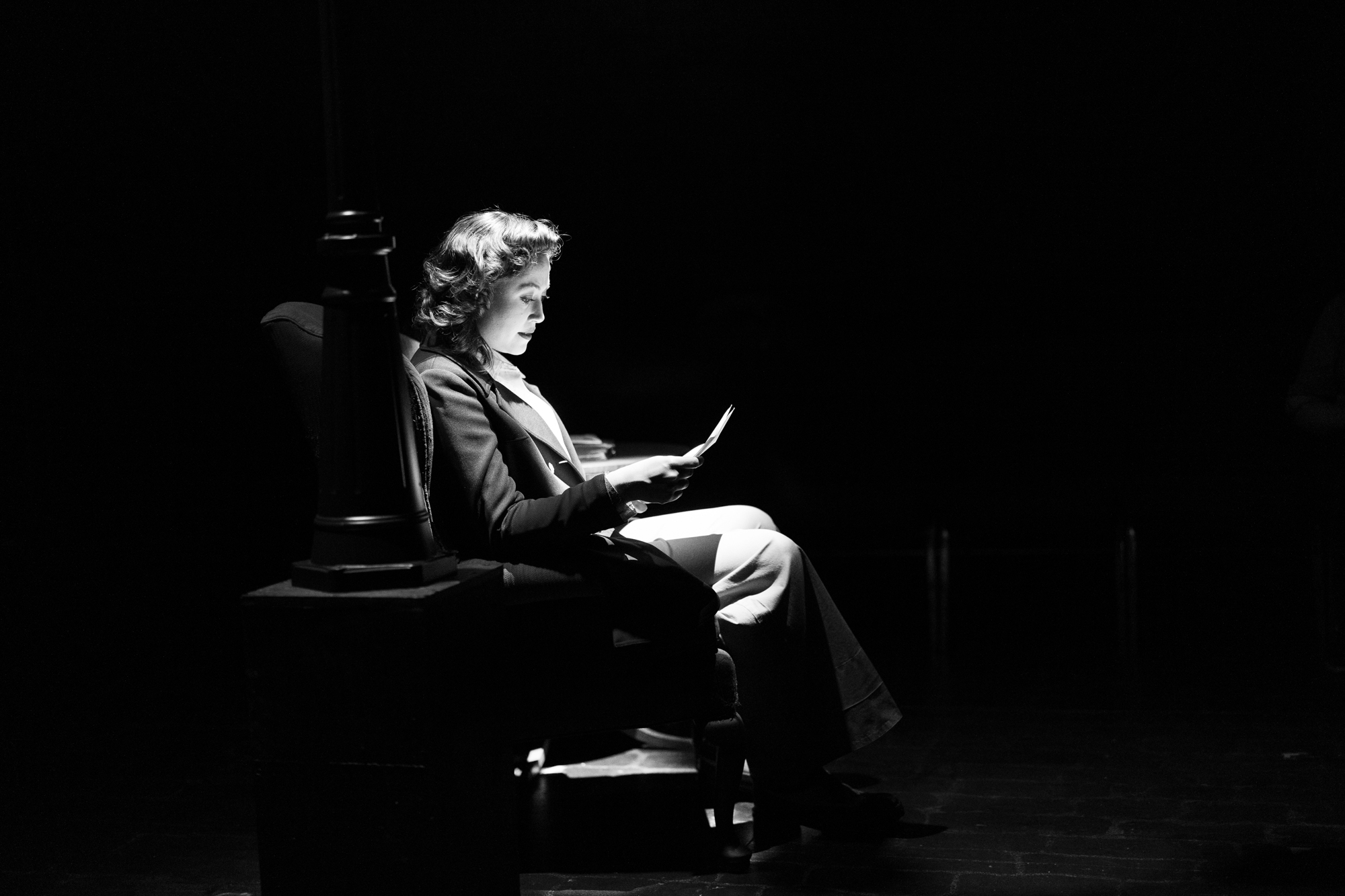
Let us now sing the praises of Anna Fernandez, an actor of uncommon talent and range. She is currently playing the title character in His Girl Watson: A Sherlock Noir, a new play by Kevin Cirone now on stage at Alleyway Theatre.
Dr. Watson is a name that resonates with fans of detective fiction, and while Fernandez is not that Dr. Watson, her character shares some uncanny similarities to him. When she is sent on an errand to 221B Baker Street (Boston, MA), the game is afoot. The play is a Sherlock Holmes-type murder mystery, set in Boston, 1946, and told in the style of film noir.
In that context, Fernandez’s Dr. Josie Watson resembles an archetypal femme fatale. Deploying a tough Boston accent, she embodies a woman who can spot a sap at twenty paces and strip him of his illusions before he’s finished lighting her cigarette -- if she smoked, that is. While she may move like a hawk through the city’s shadows, unlike a true femme fatale our Watson is also a medical doctor in a battered urban hospital, tending both to shell‑shocked boys just back from the war and to the women they bruise, seeing the damage on both sides and refusing to look away. She’s a sharp‑witted, self‑possessed, street‑wise woman whose beauty is both armor and weapon. She understands exactly how men see her and plays into that gaze just enough to get what she wants, even as she knows the world will punish her for taking that power. Indeed, Dr. Watson is the conscience of this story.
I have always thought that Fernandez is a marvelous actor with an impressive range. Strikingly beautiful, she has a wide, Katharine Cornell‑esque face made for stage light. She has been brilliant as Morticia Addams, as Nell Gwynn, and as the lead in Crazy for You. I truly sat up and took notice when she played Sybil Chase in Noël Coward’s Private Lives, taking a character who previously seemed insipid and disposable and making her distinct and purposeful. It remains the finest performance of the role I ever expect to see.
Just as she is beginning to hit her stride as a leading lady in Buffalo, I report, with mixed feelings, that as soon as His Girl Watson: A Sherlock Noire closes, Miss Fernandez will be relocating to the New York City area to try her luck in that decidedly more competitive market. Our loss is New York’s gain. Anna Fernandez’s Dr. Watson is a knockout: fierce, funny, and unforgettable.
I greatly admire playwright Cirone’s ability to craft film noir dialogue: the lines have that clipped, sardonic rhythm that feels borrowed from a 1940s soundstage, yet they sit easily in the actors’ mouths. The jokes are dry, the threats understated, and the sentiment, which slips in more often than you’d expect, almost always comes hedged in irony.
Gregory Gjurich plays Detective Brewster, the man living on Baker Street. If I told you that he is blessed with remarkable deductive reasoning but cursed with a chronic dependence on drugs and whiskey, I would already be dipping into spoiler territory. Since that’s nearly impossible to avoid, let’s just admit it: this is Sherlock Holmes, transplanted to the era of film noir, in Boston, on a specific mission. Gjurich imbues the man with that familiar air of confident superiority and unflappability, the sense of a brain always three moves ahead of everyone else in the room. At the same time, he lets us see the cracks in the façade -- the involuntary reach of his hand toward the bottle, the flash of panic quickly buried beneath a smirk -- so that this Holmes feels less like an untouchable genius and more like another gifted casualty of the world’s evil. His verbal sparring with Fernandez’s Watson has the snap of classic hardboiled banter, but underneath the wisecracks you can feel a mutual dependence that plays less like romance than like a damaged father‑and‑daughter alliance, the kind that only makes full sense once the story’s final revelations click into place.
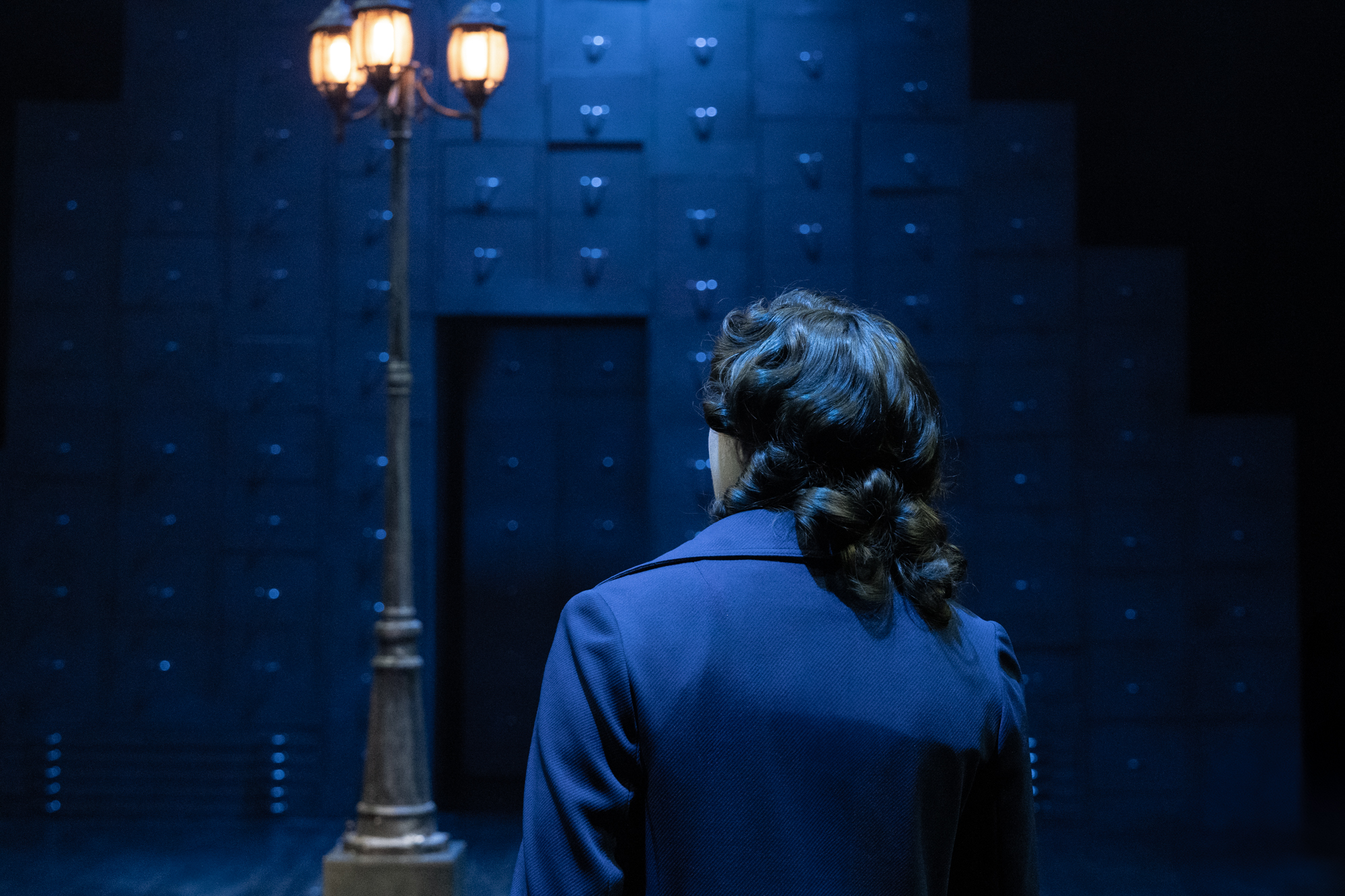
Like Alleyway’s smart rendering of Agatha Christie’s The Murder of Roger Ackroyd, directed by Chris J Handley, this production, directed by Robyn Lee, crackles with precision and moves tightly from place to place. The versatile set was designed by Jonas Harrison, who has devised a long expanse with audience at front and back, banked on one end by a towering wall of filing drawers from which random pages occasionally float down. The show has been lit by Emma Schimminger, who has also provided a brilliant sound design worthy of a film noir soundtrack. Amaya Mack’s costumes set the style while expertly evoking a world of character, all embodied by an ensemble of just four very talented actors: Jacob Albarella, Lex Cueva, Sara Kow‑Falcone, and Josh Wilde.
Lex Cueva is especially deft as a dedicated hospital nurse obsessed with the Boston Red Sox, as well as a murder victim and a gangland thug. Jacob Albarella proves wonderfully adaptable, playing a range of characters including sexist Detective Leary, who is in well over his head, and the decrepit, godfather‑like owner of a posh, mafia‑connected club. Sara Kow‑Falcone is superb as Doris Whitlock and others, running the range from brittle socialite to beleaguered working‑class housewife. Josh Wilde makes a vivid impression as charming but crooked Sonny Corelli and a handful of other shady types. Between them, they keep the stage in constant motion, a four‑person company doing the work of a dozen.
The fight choreography by Danielle Rosvally is consistently impressive, as Watson and Holmes find themselves in one increasingly dicey fix after another, dodging punches, bullets, and bodies with a balletic kind of chaos. Between the endless brawls and the pop‑art level of jeopardy, it sometimes plays like a film noir version of the 1960s Batman television show.
The murder mystery plot of His Girl Watson is a convoluted maze of smoke, mirrors, mistaken identities, and misdirection. At intermission, when folks were trying to untangle the particulars of the plot involving baseball players, the inevitable socialite, and such nonsense, I deflected, “I don’t really think it matters. The detective will summarize everything at the end.” And indeed, the real secret of this piece is to follow the Holmes and Watson relationship. It is neither romantic nor quite what it first appears.
In the end, what Cirone and Alleyway offer is less a tidy whodunit than a smoky character study in loyalty, damage, and chosen family, wrapped in a knowingly pulpy package. Fans of Holmes, film noir, or simply sharp, stylish theater will find plenty to enjoy in His Girl Watson, and may, like me, come away especially grateful for this fierce, witty new Dr. Watson and for Anna Fernandez, the remarkable actor who brings her to life.